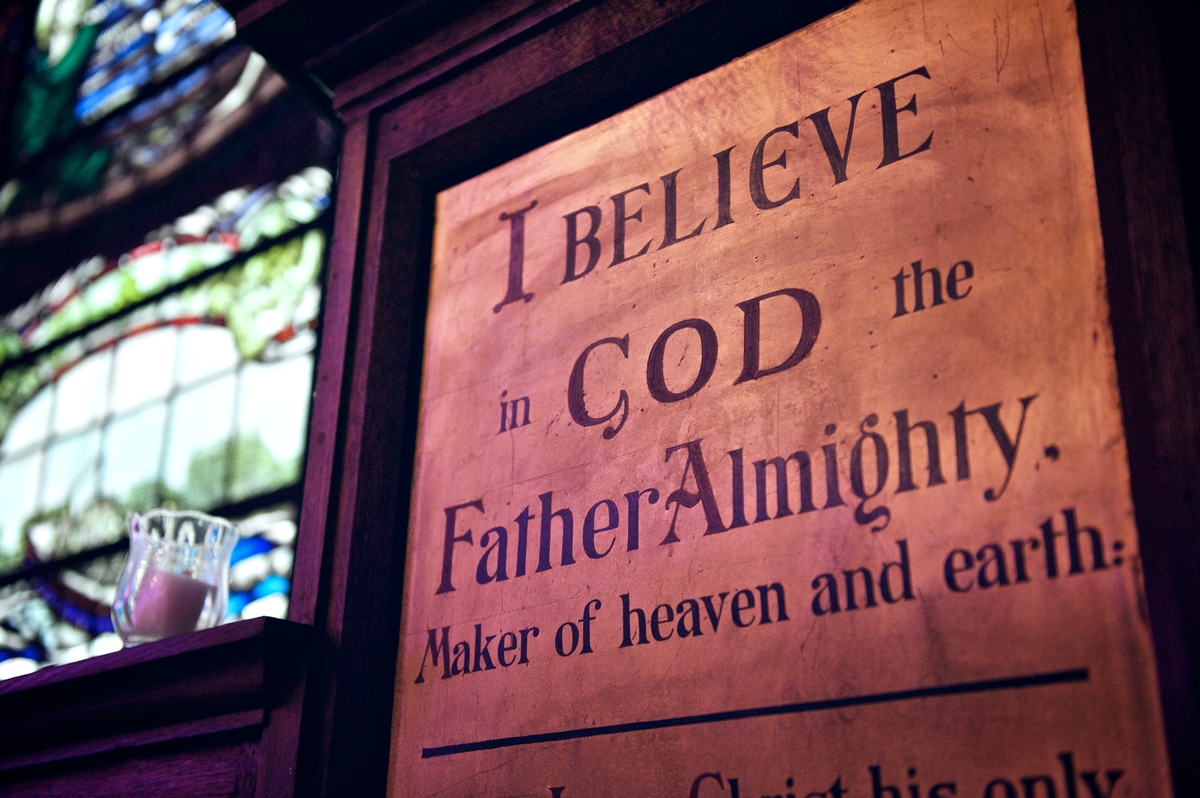
Perhaps you have heard the phrase: “No creed but the Bible!” What does that mean?
To some, this simply means that we should not elevate any creed (like the Apostles’ Creed or Nicene Creed) or church confession (like the Westminster Confession or College Park Church’s Member Covenant & Confession) above the Bible. And to that, we should agree! How can any man-made document compare to the inerrant, inspired, life-giving Word of God?
But to others “No creed but the Bible” means something more. God gave us Scripture and the Holy Spirit to guide us—isn’t that enough? Why do we need some man-made document made by imperfect and sin-tainted people?
Again, we agree, at least in part. The Bible is clear, and the Spirit illuminates Christians’ minds so that they can understand his Word (2 Cor. 2:12-16). But have you ever considered how much of your understanding of Scripture you received from others?
Church history tells the story of God’s faithfulness to sustain his church throughout the ages (Heb. 12:1-2). And the creeds tell the story of how God’s people have worked out what the Bible teaches in the face of heresy and opposition. The creeds bind us to our brothers and sisters in Christ throughout millennium and allow us to say not simply “I believe” but “we believe.”
We would be wise to consult the creeds, not as an authority, but as a help and a guide to better interpret our past, present, and future.
1. Creeds Honor the Past
Why do Christians all say that Jesus is “fully God and fully man”? Why are we so sure that God is Trinity? Why do we allow members of the church to hold different views of the end times and spiritual gifts, but we would not accept a new member who denied Christ’s resurrection?
Yes, all of this is found in Scripture. But the creeds save us time and give us confidence in our conclusions. They save us time because we don’t need to start from scratch on every issue. We have had godly Christians thinking deeply about these issues for a couple thousand years. And this in turn gives us confidence in our beliefs because we don’t have to rely on our own interpretation or even that of our church. When people in the past have died to preserve our specific understanding of the Trinity, we take notice.
2. Creeds Expose Our Current Blind Spots
We are not very good at seeing our own blind spots. That’s why they are blind spots! But time and distance usually allow us to see more clearly.
For instance, until recently many in the church with otherwise impeccable theology advocated for the right to own slaves and to treat people of color as though they were lesser. Distance allows us to see this blemish more clearly than they could at the time.
But studying church history often also works backwards, shining a light on our own imperfections. For instance, how many Christians have been caught off guard, confused, and perhaps tempted to compromise over the vast and rapidly changing cultural attitudes toward sexuality?
Apart from the clarity of God’s Word, what adds to our confidence that marriage is between one man and one woman, sex outside of marriage is wrong, and God made us male or female? The consistent witness of the church on these issues throughout the ages.
3. Creeds Give Us Confidence in the Future
Do you worry about the future? With declining church attendance and frequent public scandals, do you worry about the church’s continued growth and purity?
The creeds remind us that the church has always faced trials and troubles, even sometimes at the time of their writing, and yet the church has continued to march on. In fact, God often uses persecution to spread his truth because people become convicted when they see someone peacefully die for what they believe.
And though the church will always fight the temptation toward theological drift, God will never let his church become completely corrupt. The creeds remind us that there truly is “nothing new under the sun” (Eccles. 1:9).
The Nicene Creed was written to oppose Arianism, which says that Christ is not God but was created by God. Jehovah’s Witnesses are now simply repackaged Arians. Liberal Christianity denies that Jesus rose from the dead. With the Apostles’ Creed, we confess that on “the third day he rose again from the dead.”
The Bible says God will sanctify us completely and keep our whole selves blameless at Christ’s return: “He who calls you is faithful; he will surely do it” (1 Thess. 5:23-24).
Indeed, the creeds also testify that God will sustain his church until Christ’s return and will allow us to still say on that day: “We believe.”
Learn more about classes, like The Creeds, offered by College Park Church Institute.