Our culture is becoming increasingly polarized. The divide between opinions on politics, religion, and many other subjects seems to be growing larger by the minute. Something as simple as the topic of a healthy diet can even be controversial: one person maintains a keto diet while another person sticks to a plant-based diet. Both individuals have research that backs them up, yet both eating plans are quite different from one another. This is true for so many topics, both serious and trite.
In the same way, I find myself becoming more opinionated with each year that passes. The more I see, hear, and experience in society and around the world, the more entrenched my personal opinions can become. I am tempted to quietly (and sometimes not so quietly) judge others who believe something contrary to my opinion. Yet, in contrast, there are times when I read well-written articles or listen to convincing podcasts that can sway my opinion from one extreme to the next.
If you are like me, it can be difficult to navigate these ditches of personal opinion. So, how do we navigate these polarized ditches in a manner pleasing to the Lord?
Luke’s account of Paul’s visit to three cities in Acts 17 gives us some wisdom for our modern context. There are three very different responses to the gospel as Paul travels through two cities in Macedonia and one city in Greece. These three stops are part of his second missionary journey. While Acts 17 is specifically outlining their reactions to the gospel and doesn’t specifically relate to other topics, I think we can glean some wisdom in how to approach polarized topics in our current cultural context.
Thessalonica
First, Paul enters Thessalonica, the capital city of Macedonia, and goes straight to the synagogue to reason with the Jews. While there are some Jews and Gentiles who believe, Paul states that “the Jews were jealous” (Acts 17:5). “The Jews” is a common phrase used throughout the New Testament to refer to those who are opposed to the gospel—not generally encompassing all Jewish people. In this particular instance, these Jewish leaders did not believe that the Messiah had to suffer, were not convinced that Jesus was the Messiah, and were jealous over their loss of power since some Jewish people believed in Christ[1]. The Jews’ response was to form a mob and insight a riot. When they could not find Paul and the team, then their hosts, Jason and a few other brothers, face the mob and post a form of bail on their behalf.
Berea
Paul and his crew flee in the night to Berea, Macedonia, 50 miles southwest of Thessalonica. The Jews in Berea are described as “more noble than those in Thessalonica; they received the word with all eagerness, examining the Scriptures daily to see if these things were so” (Acts 17:11). They don’t just take Paul’s word for it. They crack open the scrolls and compare Scripture with Paul’s teaching. As Tara-Leigh Cobble says in The Bible Recap, “They walk in wisdom and humility; they’re open to receive – but not just anything. They’ll only receive the truth. Because of that, many of them believe in Jesus.” [2]
I find it incredibly instructive that this group of educated Jews who have presumably studied Scripture their whole lives are open to hearing Paul’s claims. Also, rather than immediately believing him, they spend time studying Scripture to ascertain the truth.
The jealous Jews from Thessalonica get wind of Paul, Silas, and Timothy ministering at the synagogue in Berea and come to agitate and stir up the crowds (Acts 17:13). Once again, Paul has to flee the city.
Athens
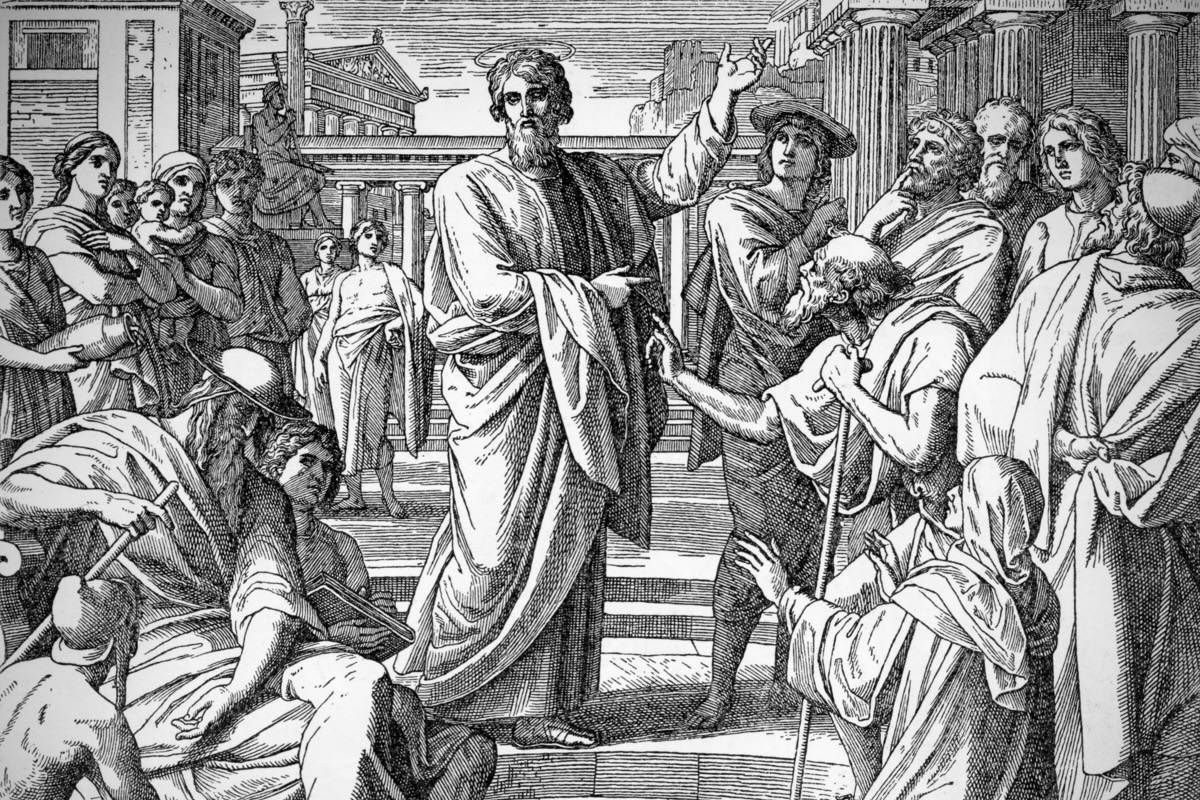
He ends up in Athens, where he is deeply disturbed that “the city was full of idols” (Acts 17:16). Athens is reported to have had some 30,000 gods at this time. Petronius, a Roman courtier and ancient historian once quipped, “[T]here are so many gods [in Athens] that it is easier to meet one than it is a man!”[3]. It is popular and expected for people to be religious and open to many gods and beliefs. There is fear that they may have missed a god, so they even have an altar ‘To the unknown god’ (Acts 17:23). So it’s understandable why Paul is so concerned about the culture and people in Athens.
Paul ministers in the marketplace, where he encounters Athenian philosophers. These interactions lead to him giving more formal presentations at the Areopagus, the high court, a long-standing establishment with extensive authority over the civil and religious life of Athens[4]. He uses his knowledge and understanding of Greek philosophy and culture to appeal to his listeners as he tells them about Jesus. When he reaches the part where Christ is resurrected from the dead, some mock him while others are willing to hear more. In the end, a few believe in Christ.
Three Responses
Looking back at these cities visited in Acts 17, we see three very different responses.
- The Jewish leaders in Thessalonica outright deny Paul and are threatened by his claims. They are self-righteous and prideful, unwilling to reason or listen to Paul.
- The philosophers in Athens are the other extreme. They are open and willing to hear Paul, yet they are open because it is popular to hear all the different religious views just in case they missed a god. The text gives the impression that Athenians could have been easily swayed by any and all differing ideas.
- The Jewish leaders in Berea show a stark contrast to those in Thessalonica and Athens. They are open to hearing Paul, yet they study Scripture to see what God’s Word says before they believe what he claims.
Take a Learner Posture
If you are like me and are inclined to have strong opinions, it’s helpful to take a learner posture. A learner posture is one that is open to hearing others and to researching how and why others might believe so strongly on an issue. I ask myself, “What if I’m wrong?” often, as a reminder that I am human and fallible and need God’s guidance in every aspect of my life.
James 3:17 says, “But the wisdom from above is first pure, then peaceable, gentle, open to reason, full of mercy and good fruits, impartial and sincere.” I believe that the Jewish leaders in Berea exemplify this posture of being a “learner” while not being gullible or easily swayed to false teaching. They don’t dig in their heels and refuse to listen like those in Thessalonica who are opposed to the gospel, but they are willing to listen and seek God’s face to ascertain the truth.
Rebecca McLaughlin in the video “Engage Political Issues with Curiosity” says, “What I’ve learned is that before I’m actually ready to talk to anybody about these important, powerful issues, I need to get myself to the point where I actually understand how somebody else who might be very intelligent, who might be very well meaning, and who might be a brother or sister in Christ could have come to precisely the opposite conclusion than I did. The best way I can take myself to that place is by actually listening. Sitting down with somebody and asking curious questions and truly seeking to understand why they believe what they believe.”[5]
Our culture will likely become more polarized as time goes on. So, as we encounter others with opposing views, may we learn from the example of the Jewish leaders in Berea who were measured, humble, curious, and discerning. May we be noble and examine the Scriptures daily and seek God’s face to guide us.
[1] ESV Study Bible. Page 2120. (Crossway Bibles, 2008).
[2] Cobble, Tara-Leigh. The Bible Recap. (Bethany House Publishers, 2020).
[3] Gaius Petronius Arbiter. The Satyricon Vol 1, Ch. 17. (Oxford University Press, 2009).
[4] ESV Study Bible. Page 2122. (Crossway Bibles, 2008).
[5] McLaughlin, Rebecca. Rebecca McLaughlin: Engage Political Issues with Curiosity. https://www.thegospelcoalition.org/video/rebecca-mclaughlin-political-issues-curiosity/. (The Gospel Coalition, May 8, 2024).