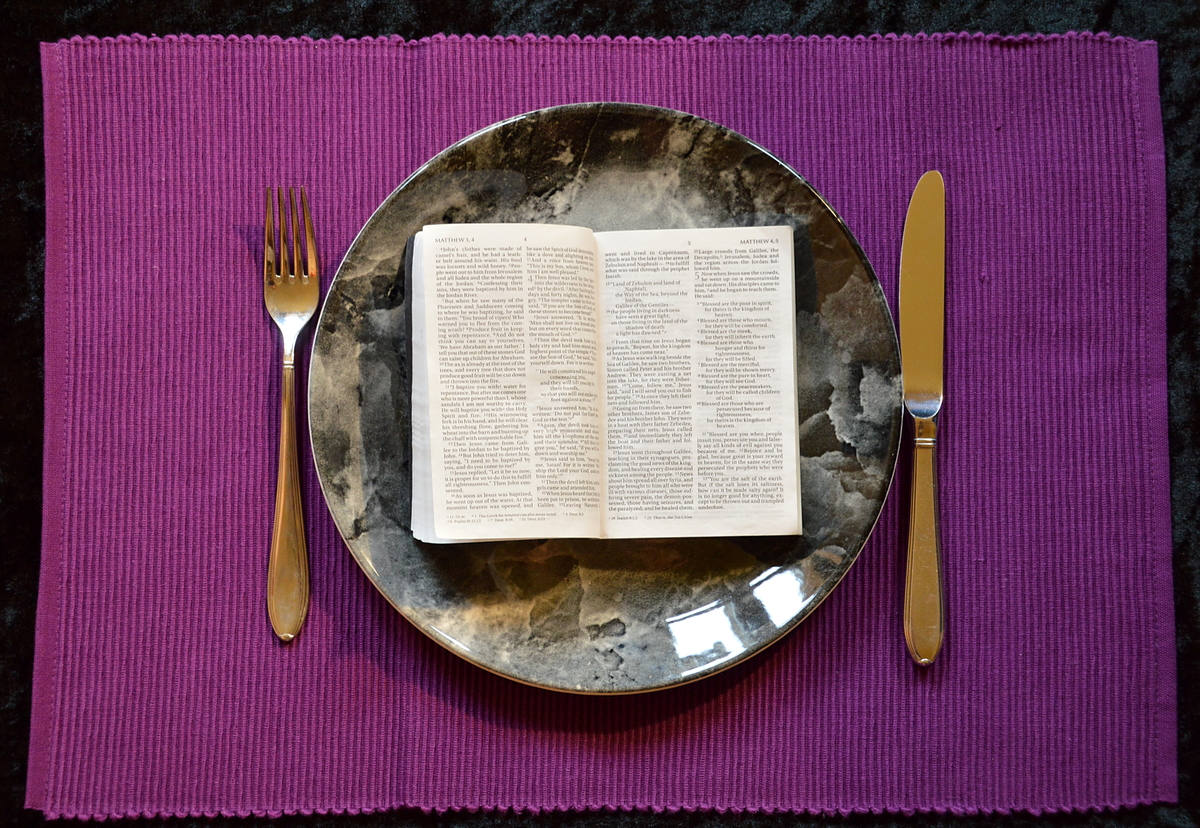
I think fasting is the most neglected spiritual practice in the Western world. And because most of us haven’t had much exposure to it, we have so many questions:
- What exactly is fasting? Can I just fast from social media?
- How can I practice it in a healthy way? What about body shame and eating disorders?
- Is it mandated in the Scriptures?
- Where do I start because it feels really intimidating?
Earlier this week, I shared a brief introduction to fasting. Now, let me briefly touch on some of the things I think we should consider as we weigh if and how we would want to try fasting as part of our spiritual lives:
1. Don’t be surprised if this is new to you.
Did you know the early church fasted twice a week: On Wednesdays to remember the day of Jesus’s betrayal, and on Fridays to remember Jesus’s death? I have a seminary degree, and I didn’t know that until recently!
Richard Foster, writing in Celebration of Discipline, said, “[I]n my research I could not find a single book published on the subject of Christian fasting from 1861 to 1954, a period of nearly one hundred years.”[1]
Although fasting has been practiced regularly by global Christians in the global South and East (such as China and throughout Africa), we in the West have been mostly silent on the topic of fasting.
2. Jesus expects but doesn’t command fasting.
As discussed in this previous article, Jesus does not command us to fast anywhere in the New Testament. But he does assume that we will do it. In the Sermon on the Mount, Jesus instructs, “When you fast” not “If you fast” (Matt. 6:16).
And later, Jesus announces that his disciples aren’t fasting because “the bridegroom is with them.” Jesus is living in their midst, and the arrival of God’s kingdom is cause for rejoicing. But, Jesus adds, “The days will come when the bridegroom is taken away from them, and then they will fast” (Matt. 9:15). This is talking about us! We fast because Jesus isn’t physically with us, and we long for him and his renewal in the world.
Our fasting is now an expression of our craving for Jesus. John Piper summarizes our experience this way:
“In other words, in this age there is an ache and a longing—a homesickness—inside every Christian that Jesus is not here as fully and intimately and as powerfully and as gloriously as we want him to be. And that is why we fast.”[2]
3. Fasting may help you physically.
I was a little amazed to hear about the health benefits of fasting.[3]
- Your body goes into “autophagy,” recycling damaged or unnecessary cells in your body.
- You probably have a friend who has gotten into the kick the last few years doing “intermittent fasting” in order to lose weight.
- In my experience, there is also a mental acuity that also comes with fasting: a sharper focus and a mental openness that isn’t there when I eat three meals a day.
Of course there are dangers to unwisely engaging with fasting. Make sure to consult your healthcare provider if you’re considering significant changes to your diet, like fasting. [4] And there are certainly challenges to fasting: like adjusting to feeling “hangry!”
Don’t misunderstand me though: Christian fasting isn’t a diet. It isn’t a cleanse. It isn’t a weight loss method.
But in light of the numerous positive effects fasting can have on our bodies, I think there is something beautiful about this. Why should we be surprised that what God invites us to do for our souls is actually good for our bodies? We are whole people, after all.
4. The purpose of fasting is abstaining from food to become more like Jesus.
Fasting is abstaining from food. Getting off of social media or doing a “TV fast” are good exercises in abstinence—but “fasting” technically has to do with food.[5] We don’t eat food, and we do drink water, over a period of time, for spiritual purposes.[6]
Let me give you three purposes that God may want for your fasting:
1. To Surrender to God
It is a way for me to say, “God, my body belongs to you.” When I skip lunch, I feel viscerally that I am presenting my body “as a living sacrifice, holy and acceptable to God, which is [my] spiritual worship” (Rom. 12:1-2).
Unfortunately, I regret that I’ve spent most of my life not making many attempts to surrender to God in this way. I didn’t start practicing regular fasting until last year. But this has become the biggest benefit to me: regular time and space set aside to meet with God and say, “I don’t need food; I need you.”
2. To Become More Like Jesus
A breakthrough moment came to me when I was listening to a podcast on fasting. The thought occurred to me for the first time in my life: “Could I be formed by God not just through my head, but through my stomach?”
Fasting breaks my attachments to the things that I want in order to realize that God is my provider and that what I really hunger for is God. My stomach gets to be like an alarm clock reminding me that I need God. I love the title of John Piper’s book on fasting: A Hunger for God!
3. To Amplify Our Prayers
Although you can do them independently, fasting and prayer go together. Fasting leads us to prayer. Fasting sharpens our mind. We’re more alert, focused, and open. And we can enter into prayer more effectively as we talk to our unseen God who hears.
Story after story in Scripture shows how fasting offers some sort of breakthrough to God’s work through our prayers. It’s pretty undeniable that the who’s who of Scripture fasted and experienced God radically hearing and breaking through to act on their behalf:
- Moses received divine access on the mountain (Ex. 34:28-35)
- Elijah received his still, small voice (1 Kings 19:8)
- Esther received deliverance for the Jews in Persia (Est. 4:16)
- Jesus received preparation for satanic temptation (Matt. 4)
- Paul received radical conversion (Acts 9:9)
And that’s just a few!
God may be waiting for us to fast and pray for him to act in a significant way.
How to Start Fasting
If Jesus, the saints of Scripture, and so many Christians throughout time and throughout the world have seen God work through fasting—we are left with the question: Why wouldn’t we fast too?
So, don’t plan a forty-day fast. I recommend considering a 24-hour fast. Organize a day where you won’t eat from sundown until sundown the following day. Essentially, skip breakfast and lunch one day. And, instead, use that time to commit your body to God, be open to your need for him, and pray for the things he brings to mind.
For those who have tried this practice before, make a plan for how you could incorporate fasting for a day on a regular rhythm: perhaps monthly or even weekly. Then you can personally experience God’s power through using your body. As Jesus told us:
“. . . [T]hat your fasting may not be seen by others but by your Father who is in secret. And your Father who sees in secret will reward you” (Matt. 6:16-18).
[1] Richard Foster, Celebration of Discipline, (HarperCollins: 2018), p.47.
[2] From his sermon titled “When the Bridegroom Is Taken Away, They Will Fast—With New Wineskins,” delivered on January 3, 1993.
[3] Numerous studies have engaged with the benefits of various forms of fasting, leading to its rise in popularity currently in the West (e.g. this study by Nutrition Journal).
[4] While fasting may be helpful for many people, it may put others’ health at risk. Your healthcare provider will know your situation best. Also include your counselor or mental health worker in this decision if you think you may struggle with body-related issues such as eating disorders.
[5] I don’t think it is overly problematic to use the phrase “social media fast,” but it misses how this is a bodily discipline. Many define fasting more broadly, such as Martin Lloyd-Jones: “fasting should really be made to include abstinence from anything which is legitimate in and of itself for the sake of some special spiritual purpose” (Studies in the Sermon on the Mount, vol. 2 (Grand Rapids: Eerdmans, 1960), 38. 3, in sermon “Fasting (6:16-18).). But a precise definition of fasting as food-related helps us to practice the actual practice of Jesus and his followers (Matt. 6:16). Even when Isaiah points to God’s “fast” as “to let the oppressed go free” (Isa. 58:6-10), he is adding sincere generosity (historically called almsgiving) to the people’s food fasting (Isa. 58:3-5). He’s not just trying to broaden the definition of “fasting.”
[6] Historically, there are different types of fasts: regular fasts (abstaining from food and only drinking water), partial fasts (abstaining from certain types of food), and absolute fasts (abstaining from all food and drink).